
Rethinking Tokyo Sightseeing From a Different Angle — A Thorough Look at the Street Kart Experience Based on Official Info
When you’re planning a trip to Tokyo, beyond the usual walking and train-hopping between famous spots, there’s an option that turns the journey itself into part of the adventure. That’s the street kart experience. Because you’re continuously taking in the city scenery as you go, it hits differently from the point-to-point travel of hopping between train stations — you get to feel the spread of the city and the unique vibe of each area as it flows past you.
That said, street kart isn’t like your typical indoor attraction or museum visit — it operates on public roads. So there are clear things you need to check before booking. For example, the required driver’s license documents, meeting times, course duration, dress code notes, and conditions for reservation changes or cancellations all need to be sorted out ahead of time. Rather than going on vibes alone, checking the official site for requirements before fitting it into your itinerary leads to a much more realistic plan.
The official source for information is the Street Kart official website https://kart.st/en/. Details about driver’s license requirements can be found at https://kart.st/en/drivers-license/. Since participation conditions may vary depending on each visitor’s situation, it’s essential to check the relevant page before making a reservation.
Thinking About Street Kart Within Your Tokyo Trip
Tokyo is a city where the feel of the streets can shift dramatically within a single day. From areas lined with skyscrapers to open waterfront zones near rivers and the bay, busy main roads to quiet residential neighborhoods — the scenery changes noticeably even over short distances. This characteristic of the city becomes much easier to grasp when you experience not just the destinations, but the journey between them.
The street kart experience is a tourism activity that makes it easy to feel that continuity of Tokyo. Instead of looking in just one direction from inside a vehicle, you’re aware of the changing scenery and roadside atmosphere all around you, making it easier to experience the city as a continuous line rather than isolated points. The fact that you can grasp places you’ve only seen in photos or on maps — complete with a sense of distance and atmosphere — is one reason it fits naturally into a Tokyo trip.
However, this experience is better suited to “sorting out the conditions and then booking” rather than “casually deciding on the spot.” The reason is simple: if your documents or meeting requirements aren’t in order, it directly impacts your plans for the day. When considering it as a sightseeing option, checking participation conditions alongside the appeal of the experience helps stabilize your entire itinerary.
Driver’s License Requirements — The First Thing to Check Before Booking
When considering the street kart experience, the very first thing to confirm is whether you can prepare the documents needed to legally drive in Japan. The official site lists several categories of accepted documents for driving in Japan — specifically, a Japanese driver’s license, an International Driving Permit, SOFA-related documents, or in certain cases, your home country’s license along with an official Japanese translation. Which documents you need depends on the type and issuing conditions of the license you hold, so rather than going by general assumptions, you need to check according to the official guidelines.
What’s especially important is that bringing original documents is a prerequisite. The official site states that if you don’t have the required original documents, you cannot participate and no refund will be given. This is a critical factor in your booking decision. For travelers, preparing license-related documents should be treated with the same priority as arranging accommodation and transportation.
The official site also notes that International Driving Permits cannot be issued within Japan, so you need to obtain one before arriving. Since this isn’t something you can handle after departure, it’s something to confirm during the planning stage, not right before your trip. If you put off checking your required documents, you might find available time slots but still be unable to meet the participation requirements.
Details on license categories are compiled at https://kart.st/en/drivers-license/. Since applicable conditions need to be checked individually, it’s best to review the official page before booking rather than relying solely on articles or reviews.
Breaking Down the Tokyo Bay Area Course Based on Official Info
According to the official site’s Tokyo Bay information, the course duration at the Tokyo Bay shop is approximately 1.5 to 2 hours. It also notes that this can vary depending on traffic conditions. When building your sightseeing schedule, you need to work with this “range of duration” as your baseline. Unlike a timed event at an indoor venue with fixed end times, it’s better to build in some buffer for travel and traffic conditions.
Regarding the course content, the official site describes departing from the Tokyo Bay shop, passing through an industrial zone, crossing Rainbow Bridge, taking in views of Tokyo Bay and the urban landscape toward Tokyo Tower, then crossing the bridge again to return to the shop. In the context of Tokyo sightseeing, the highlight of this route is being able to see both the waterfront expanse and the central city skyline within a single continuous flow. Tokyo’s scenery includes many elevation changes and shifts in building density that only become apparent from ground level, and moving from the bay area toward the city center is a route well-suited to feeling those transitions.
The Tokyo Bay area is a region where walking alone won’t give you the full picture due to distance, and trains alone tend to make the in-between scenery fragmented. So for people who want to see the city as a “connected experience” rather than isolated “points,” it’s a solid option to work into your itinerary. Unlike sightseeing where you spend a long time at a specific landmark, the shifting scenery itself is what tends to leave a lasting impression — that’s what makes the street kart experience in this area distinctive.
How to Work Access Info Into Your Itinerary
According to the official site, the Tokyo Bay shop is located in Shinkiba, Koto-ku, Tokyo, with a walk of about 10 to 13 minutes from the nearest Shinkiba Station. The listed train lines include the JR Keiyo Line, Tokyo Metro Yurakucho Line, and Rinkai Line. When sightseeing in Tokyo, it’s easy to focus on efficient station-to-station travel, but in reality, “the time you arrive at the station” and “the time you actually reach the shop and start check-in” aren’t the same. Overlooking this gap can make it hard to meet the gathering requirements.
Especially while sightseeing, navigating inside stations, finding the right exit, adjusting your luggage, and getting your bearings on surrounding streets can all take longer than expected. Estimating not just your arrival time at Shinkiba Station but also the walking time from there to the shop is what makes for practical itinerary management. If you book a morning slot, check travel time from your hotel; for an afternoon slot, confirm the number of transfers and distances between stations from your previous sightseeing spot to keep things stress-free.
The Tokyo Bay area has a different sense of distance compared to the dense central city areas, so even places that look close on a map may require significant walking or transfer time. To naturally incorporate the street kart experience into your Tokyo trip, you need to plan backward from the condition of “arriving at the shop 30 minutes before your reservation” rather than just looking at how destinations relate to each other on a map.
Why It Pays to Know the Day-Of Flow in Advance
The official site also outlines the activity flow for the Tokyo Bay shop. This includes arriving at the shop at least 30 minutes before your reserved time, confirming your reservation details upon arrival, presenting a valid driver’s license and identification documents, receiving a wristband, filling out a questionnaire, storing your belongings, choosing a costume, receiving a driving briefing from the guide, and then departing.
What this tells you is that a certain amount of prep time is needed before the experience even starts. If you approach it with a sightseeing mindset of “I just need to show up at start time,” you’ll end up rushed during check-in. Since there’s a recommended arrival time separate from the reservation time, your travel plans need to be built around that assumption.
Also, during check-in, depending on your license category, you may need to present identification documents in addition to your driver’s license. If your required items are buried deep in your bag when you arrive, the check-in process can get clunky. It’s more practical to have everything ready to present before you even walk into the shop. Belongings tend to pile up while traveling, but keeping your essential documents easily accessible can reduce hassle on the day.
The pre-departure driving briefing is also an important detail. Since this experience takes place on public roads, following the preparation flow as outlined is a given. When working it into your itinerary, building in buffer time before and after — and not cramming in your next activity too tightly — will make things much smoother.
Think Practical, Not Fashionable, When It Comes to Clothing and Belongings
The official site advises against heels, sandals, and long skirts. This isn’t about aesthetics — it should be understood in terms of ease of movement and driving operation on the day. While Tokyo sightseeing generally calls for comfortable walking shoes, on a day when you’ve got a street kart experience planned, you need to pay extra attention to footwear and how easily you can move in your clothes.
Depending on the season, factoring in the wind chill and temperatures around the bay area can also help reduce discomfort on the day. If you’re joining straight from other sightseeing, an outfit that lets you comfortably get through everything from check-in to the driving briefing is more suitable than one chosen for photo ops. Especially on long schedule days, thinking about whether you need a change of clothes and how much luggage you’re carrying helps streamline your movement.
The top priority item to bring is the original copies of your required documents. Depending on your situation, you may need identification documents in addition to your license. Prepare according to what’s listed on the official site, and don’t assume you can substitute with alternatives on your own. If a shortfall is discovered on-site, it can easily throw off your entire day’s plans, so confirming your belongings the day before is the safest bet.
The official site also mentions a flow where belongings are stored in lockers. Showing up with large bags can slow down both your walk from the station and the check-in process. If you’re joining mid-sightseeing in Tokyo, making use of your hotel or station coin lockers and coming with just your essential documents and minimal belongings will make things much easier.
How to Read the Reservation Changes, Cancellation Policy, and Insurance Info
The official site notes that reservation changes — such as group size, date/time, and course — may be possible depending on availability. However, it also states that cancellation policies apply from 6 days before the date of use. Travel plans can shift due to transit situations or changes in your stay, but changes aren’t always freely available. The less finalized your schedule is, the more reason there is to read the conditions before booking.
Regarding insurance, the site states that a standard insurance plan including basic coverage is included in the tour fee. On top of that, it clearly notes that in the event of vehicle damage due to contact, scratches, or accidents, a deductible of 50,000 yen per vehicle will be charged. There’s also mention of optional additional plans available for an extra fee, but it’s easier to make informed decisions if you check what’s covered under the standard plan versus what falls under separate conditions before booking.
This kind of information tends to fly under the radar, but it actually relates to your overall travel budget and scheduling. To smoothly incorporate the street kart experience into your sightseeing, it’s important to check not just the duration and scenic impressions, but also the cost conditions and change policies. Especially when going as a group, one person’s misunderstanding can affect everyone’s plans, so getting everyone on the same page beforehand makes coordination much easier.
Putting It All in Perspective Within Your Tokyo Trip
The street kart experience fits better into a day when you want to enjoy the journey itself, rather than a packed itinerary focused on hitting as many famous spots as possible in the shortest time. It pairs well with moments when you want to feel the shifting scenery and connections between different areas, rather than just focusing on arriving at destinations.
For example, unlike a day spent lingering at observation decks or shopping complexes, it’s suited for “a day when you want to feel the spatial expanse of Tokyo” or “a day when you want the visual transition from the bay area to central Tokyo to stick with you.” Walking-focused sightseeing is great for catching a neighborhood’s details, and train-based sightseeing excels at efficiency, but the street kart experience offers a different rhythm for rediscovering the city — and that’s where its value lies.
Even for repeat visitors, there’s the possibility of perceiving areas you already know from a different sequence and sense of distance. Spatial relationships you thought you understood from maps can become much more concrete through actual road-level travel. So for those who prioritize not just “what to see” in Tokyo but “how to feel the city,” this is an experience worth considering.
That said, don’t just add it to your plans based on appeal alone — the mindset of first confirming whether you can meet the participation requirements is essential. Sort out the required documents, meeting times, duration range, dress code, and cost conditions, then realistically judge whether it fits into your itinerary without strain.
Final Check Before Booking
If you’re considering the street kart experience in Tokyo, start by checking the shop page on the official site https://kart.st/en/ to organize course details, duration, meeting location, day-of flow, and change conditions. Then, confirm driver’s license requirements at https://kart.st/en/drivers-license/ and determine early on whether you can prepare the necessary documents in their original form.
For the Tokyo Bay area, the official site covers the approximately 1.5 to 2 hour course, traffic-dependent variations, arriving 30 minutes early, the walk from the nearest station to the shop, dress code notes, reservation change and cancellation conditions, and insurance and deductible information. Familiarizing yourself with all of this beforehand makes it easier to catch the practical details that impressions alone might miss.
The street kart experience is a sightseeing activity worth considering for anyone who wants to see Tokyo’s scenery as part of a continuous journey. To incorporate it naturally into your Tokyo trip, give equal weight to both the scenic appeal and the participation conditions, and make your decisions based on official information. For detailed confirmation before booking, please refer to the official site.
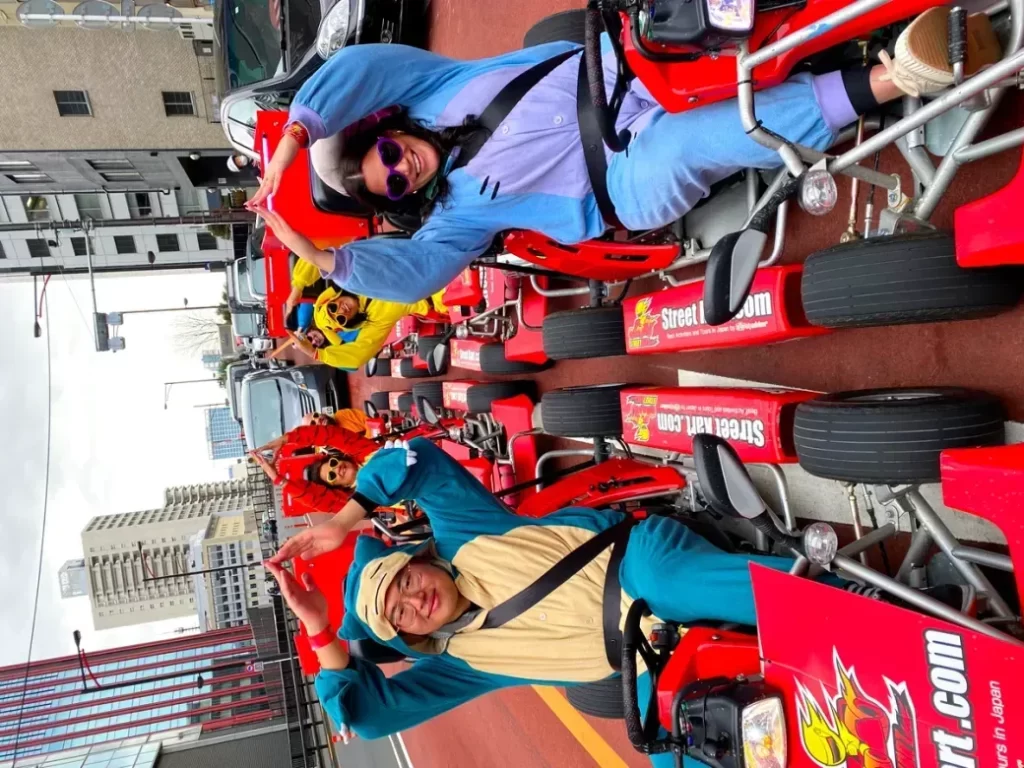
Costume Information
Our shop does not offer rental of Nintendo or “Mario Kart” related costumes. We only provide costumes that respect intellectual property rights.

